SEO Case Study 2 – Transforming Search Data into a Scalable SEO Strategy


Business Background
Modern SEO projects rarely fail because websites lack content. More often, they struggle because years of continuous growth create technical debt, fragmented information architecture, inconsistent content quality, and inefficient internal structures that gradually reduce organic performance.
This project represented exactly that situation. The website had already earned meaningful visibility across Google Search and ranked for numerous commercial keywords. However, increasing visibility alone was no longer the primary objective.
The real challenge had shifted toward maximizing the commercial value of existing organic traffic.
Instead of asking:
“How can we get more pages indexed?”
The more valuable question became:
“How can we generate significantly more business from the visibility the website already has?”
Answering that question required looking beyond rankings and examining how every layer of the website contributed to search performance and business growth.
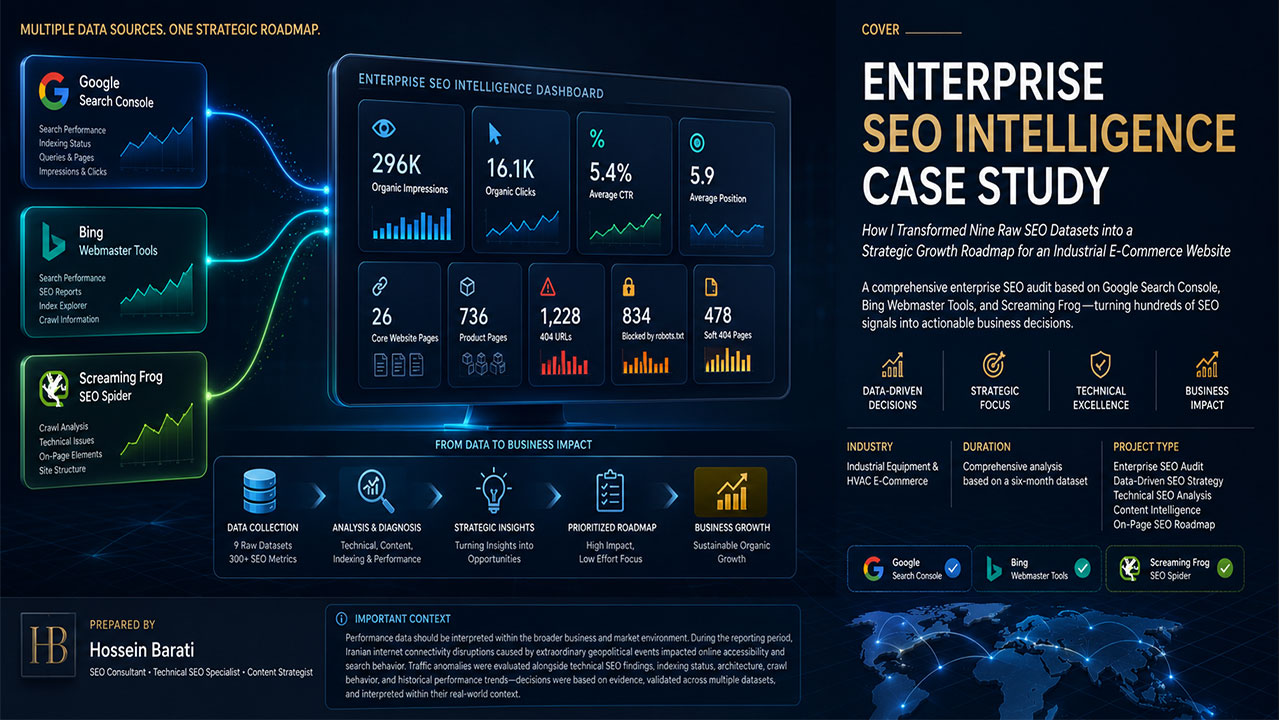
The Challenge In SEO Case Study
The Challenge In SEO Case Study
- At first glance, the website appeared healthy.
- Organic visibility was stable.
- Numerous pages ranked on the first page of Google.
- Brand-related queries performed strongly.
- Search impressions continued to grow.
- However, deeper analysis revealed a very different story.
Several critical SEO issues were limiting the website’s ability to convert existing visibility into sustainable business growth.Among the most important observations were:
- A large number of non-indexed URLs affecting crawl efficiency.
- Significant volumes of broken (404) pages accumulated over time.
- Soft 404 pages reducing perceived content quality.
- Product pages lacking comprehensive on-page optimization.
- Landing pages with strong rankings but below-average click-through performance.
- Opportunities to strengthen internal linking and semantic relationships between pages.
- Content quality inconsistencies across commercial pages.
None of these issues alone explained the website’s overall performance. Together, however, they created a compounding effect that limited long-term organic growth.
This made the project fundamentally different from a conventional SEO audit. The objective was not simply to identify problems. It was to understand how those problems interacted and to prioritize the improvements capable of generating the highest business impact.
Why This Project Was Different
Many SEO audits end with hundreds of technical observations and generic recommendations. This SEO project followed a different philosophy. Every technical finding was evaluated through a business lens.
Instead of asking whether an issue existed, the analysis focused on three practical questions:
- How does this issue affect organic growth?
- How difficult is it to implement a solution?
- What measurable business value can be expected after implementation?
This approach transformed the audit from a technical document into a strategic decision-making framework.
Rather than overwhelming stakeholders with isolated SEO metrics, the analysis prioritized actions according to their expected commercial impact.
The outcome was not simply a list of website issues, but a structured roadmap that connected technical improvements, content optimization, user experience, and search performance with long-term business objectives.
Key Takeaway
Effective SEO is not about fixing isolated technical issues. It is about transforming search data into strategic decisions that create sustainable business growth.
Audit Methodology
A reliable SEO strategy begins with reliable data. Rather than relying on assumptions or automated scoring tools, this project followed an evidence-based methodology built entirely on first-party search data and technical website analysis.
The objective was not simply to identify isolated SEO issues, but to understand how multiple technical, structural, and content-related factors interacted to influence organic performance.

A reliable SEO strategy
Instead of evaluating individual metrics independently, the website was analyzed as an interconnected search ecosystem where indexing, crawlability, content quality, internal linking, metadata, structured data, and user experience collectively affect search visibility.
Each recommendation presented throughout this case study is supported by measurable evidence extracted directly from the website’s own data.
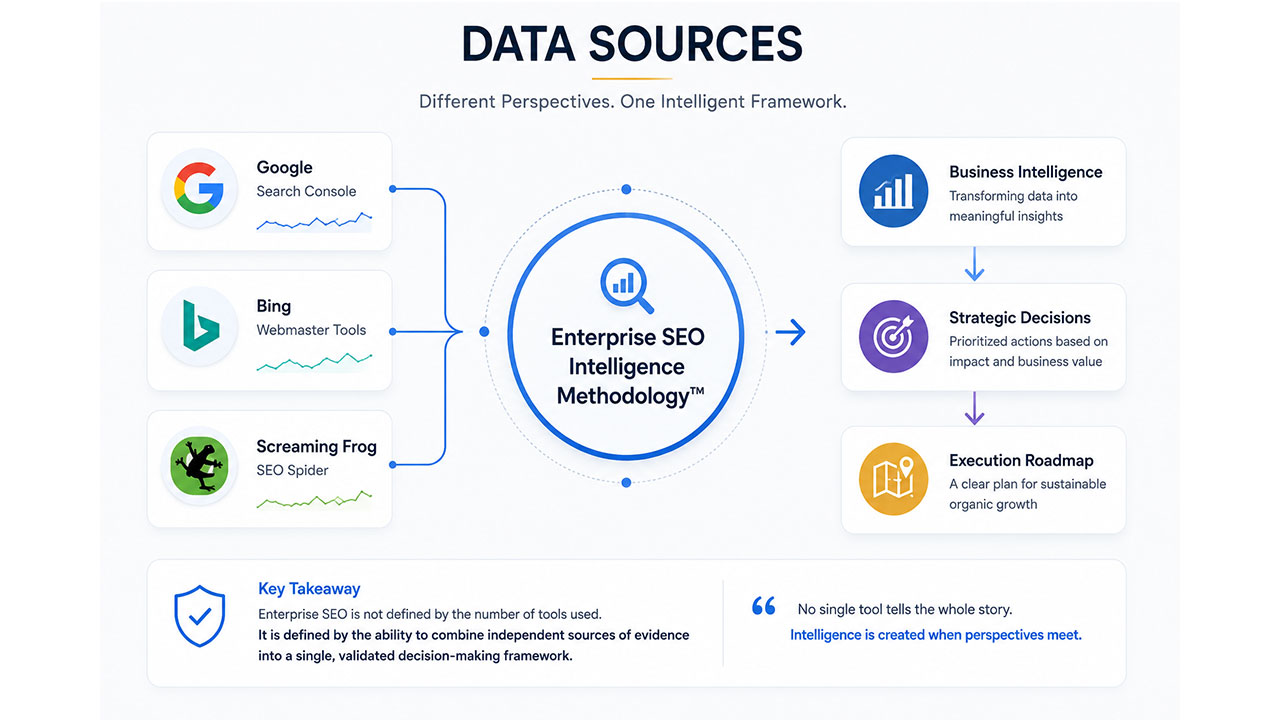
(Google Search Console + Bing + Screaming Frog Image)
Data Sources
(Google Search Console + Bing + Screaming Frog Image)
Three complementary data sources were combined to build a complete picture of the website’s SEO performance.
Google Search Console
Google Search Console served as the primary source for understanding how Google interacted with the website.
The analysis included:
- Organic Clicks
- Impressions
- Average CTR
- Average Position
- Landing Page Performance
- Query Performance
- Index Coverage
- Search Visibility Trends
This dataset provided direct insight into how users discovered the website through Google Search.
Bing Webmaster Tools
Bing Webmaster Tools was used to validate technical observations from an additional search engine perspective.
Its reports helped identify crawl behavior, indexing patterns, XML sitemap status, and technical consistency that could influence overall search accessibility.
Although Google remained the primary search engine evaluated, Bing data added an additional layer of technical validation.
Screaming Frog SEO Spider
To complement search engine data, a complete technical crawl of the website was performed using Screaming Frog.
More than 300 technical signals were extracted for every crawlable URL, including:
- HTTP Status Codes
- Canonical Tags
- Meta Robots
- Titles & Meta Descriptions
- Heading Structure
- Word Count
- Crawl Depth
- Internal Links
- Response Time
- Structured Data
- Image Optimization
Combining crawler data with search performance metrics allowed every recommendation to be supported by both technical evidence and real search behavior.
Technical Findings
The technical audit revealed that the website had already achieved a solid level of search visibility, but several structural issues were limiting its ability to maximize organic performance.
Instead of identifying one critical problem, the analysis uncovered multiple moderate-impact issues that collectively reduced crawl efficiency, content quality, and click performance.

Technical Findings
The most significant findings included:
- 1,228 broken (404) URLs.
- 834 URLs blocked by robots.txt.
- 478 Soft 404 pages.
- 113 Alternate Canonical pages requiring evaluation.
- Hundreds of product pages lacking comprehensive On-Page SEO.
- Landing pages with high visibility but below-average CTR.
- Internal linking opportunities between commercial pages.
- Missing or incomplete structured data across important URLs.
Individually, none of these findings explained the website’s overall performance.
Collectively, however, they represented a significant opportunity for long-term SEO growth.
Index Coverage Analysis
One of the most valuable discoveries of the project came from the Index Coverage analysis.
Search engines cannot rank pages they choose not to index.
For that reason, improving index quality often delivers greater long-term value than simply publishing additional content.
The analysis identified several categories of non-indexed URLs, each requiring a different strategy rather than a single technical solution.

Index Coverage Analysis
The largest groups included:
Broken URLs (404)
More than 1,200 broken URLs had accumulated over time.
These pages increase crawl waste, reduce user experience, and frequently indicate outdated internal architecture or historical URL changes.
Each URL requires individual evaluation to determine whether it should be redirected, permanently removed, or consolidated with another page.
Blocked URLs
The audit also identified 834 URLs blocked by robots.txt.
Blocked pages are not necessarily problematic.
However, every blocked URL should be reviewed to ensure that valuable commercial pages are not being unintentionally excluded from crawling.
Soft 404 Pages
Nearly 500 Soft 404 pages suggested that Google considered many URLs to have insufficient value. These pages typically contain very little original content, thin category descriptions, weak product information, or templates that provide limited usefulness to users.
Improving content quality on these pages represents a significant opportunity to strengthen index quality.
Alternate Canonical Pages
Canonicalization was generally implemented correctly. However, several alternate canonical pages required manual review to confirm that important commercial URLs were not unintentionally transferring ranking signals elsewhere.
Rather than treating every non-indexed page as an error, the audit categorized each URL according to its business value and recommended the appropriate action: retain, consolidate, redirect, improve, or remove. This prioritization helps reduce crawl waste while allowing search engines to focus on the pages that matter most.
Crawl Budget Analysis
For websites containing hundreds of products and thousands of discoverable URLs, crawl efficiency becomes a strategic SEO factor.
Every unnecessary URL consumes part of the search engine’s crawl resources. Broken pages, duplicate URLs, low-value content, and obsolete pages reduce Google’s ability to revisit and evaluate the URLs that actually generate business value.
The crawl analysis indicated that improving crawl efficiency should become an early implementation priority.
Recommended actions included:
- Eliminating obsolete URLs.
- Redirecting historical pages where appropriate.
- Reducing unnecessary crawl paths.
- Improving internal navigation.
- Consolidating duplicate content.
- Strengthening high-value landing pages.
Rather than attempting to increase crawl frequency, the objective is to ensure that Google’s existing crawl budget is spent on the most valuable sections of the website.
CTR Analysis
(Google Search Console Performance Screenshot)
One of the most important business insights emerged from the click-through rate analysis. Contrary to common assumptions, the website did not suffer from a lack of impressions.
In fact, many commercial pages were already receiving substantial visibility in Google Search. The real challenge was converting that visibility into clicks.
This distinction fundamentally changed the strategic direction of the project. Instead of prioritizing large-scale content production, the audit focused on increasing the efficiency of existing search visibility.
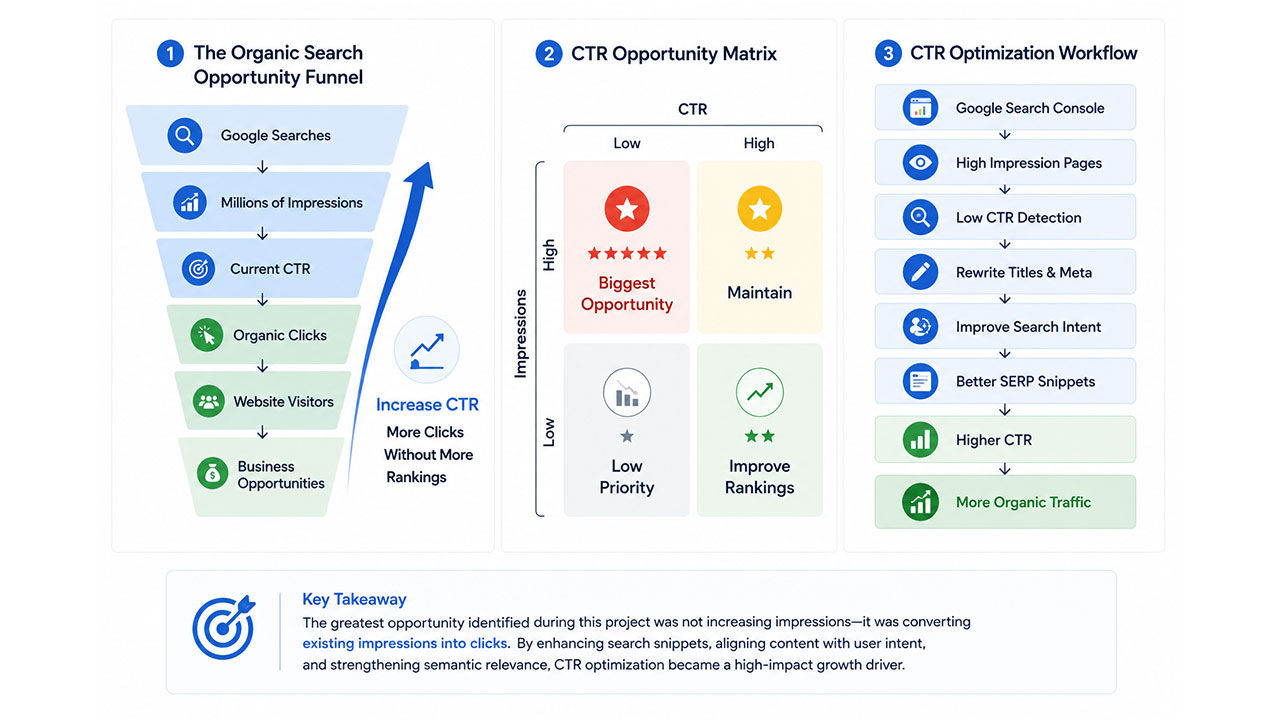
(Google Search Console Performance Screenshot)
Several optimization opportunities were identified:
- Rewriting page titles to improve relevance and click appeal.
- Enhancing meta descriptions with clearer value propositions.
- Aligning titles with user search intent.
- Strengthening semantic relevance between queries and landing pages.
- Improving structured data to increase SERP visibility.
- Optimizing underperforming pages already ranking on the first page of Google.
For many URLs, even a modest improvement in CTR could generate meaningful increases in organic traffic without requiring higher rankings.
This finding positioned CTR optimization as one of the highest-return initiatives within the entire SEO roadmap.
Key Takeaway
The website’s greatest growth opportunity was not increasing visibility—it was maximizing the value of the visibility it had already earned. By improving index quality, crawl efficiency, and click-through performance, the existing organic presence could generate substantially greater business results without relying solely on new content production.

Product SEO Analysis
Product SEO Analysis
(Product SEO Framework Illustration)
The website contained 736 commercial product pages, representing the largest searchable asset across the entire platform. Although these pages generated valuable search visibility, the audit revealed that a significant portion lacked the fundamental elements required for modern e-commerce SEO.
Rather than isolated technical issues, the analysis identified a recurring pattern of incomplete on-page optimization across the product catalog.
The primary opportunities included:
- Incomplete or under-optimized page titles.
- Generic or missing meta descriptions.
- Weak keyword targeting.
- Limited internal linking between related products.
- Missing or incomplete Product Schema implementation.
- Insufficient product descriptions.
- Missing FAQ content.
- Limited supporting commercial information.
- Inconsistent image optimization and ALT attributes.
While each issue appeared relatively small in isolation, their cumulative effect significantly reduced the organic potential of the product catalog.
The audit recommended treating product pages not merely as inventory listings, but as comprehensive landing pages capable of satisfying both user intent and search engine quality signals.
Each product page should ultimately function as a complete commercial resource rather than a simple product description.
Recommended Product SEO Framework
For every product page, the implementation roadmap included:
- Optimized SEO Title
- Persuasive Meta Description
- Primary Keyword Mapping
- Product Schema Markup
- High-quality Product Description
- Image ALT Optimization
- Contextual Internal Links
- FAQ Section
- Initial Review & Rating Structure
- Related Product Connections
Rather than applying identical templates across all products, every optimization should reflect the product’s search intent, commercial value, and topical relevance.
Content Quality Analysis
One of the strongest findings of the audit was that content quality—not content quantity—had become the primary limiting factor for further organic growth.
The website already contained a substantial number of indexed pages. Publishing additional content without improving existing pages would likely deliver diminishing returns.
Instead, the audit focused on evaluating how effectively current pages satisfied user intent. Each important landing page was assessed across multiple qualitative dimensions, including:
- Search Intent Alignment
- Topical Coverage
- Semantic Relevance
- Content Depth
- Heading Structure
- Readability
- Internal Context
- Commercial Value
Several recurring patterns emerged. Some pages contained technically correct information but lacked sufficient topical depth. Others addressed only a portion of the user’s search intent, leaving important questions unanswered.
Certain pages relied heavily on generic descriptions without demonstrating practical expertise or commercial differentiation. Rather than recommending wholesale content replacement, the strategy prioritized content enhancement.
Existing pages with established rankings represented valuable assets. Strengthening them through semantic expansion, improved structure, and clearer information architecture offered significantly greater long-term value than creating large volumes of new content.
Content Strategy Principles
Every content improvement was designed around five core principles:
- Search Intent First
- Semantic SEO
- Entity-Based Optimization
- User-Centered Writing
- Topical Authority Development
This methodology ensures that content performs well not only for traditional keyword rankings but also within modern AI-driven search environments.
E-E-A-T Analysis
Google increasingly evaluates websites based not only on technical quality but also on the credibility and trustworthiness of their information.
For commercial websites operating in specialized industries, demonstrating expertise is becoming just as important as technical optimization.
The audit evaluated the website through Google’s E-E-A-T framework:
- Experience
- Expertise
- Authoritativeness
- Trustworthiness
Several opportunities were identified to strengthen these quality signals.
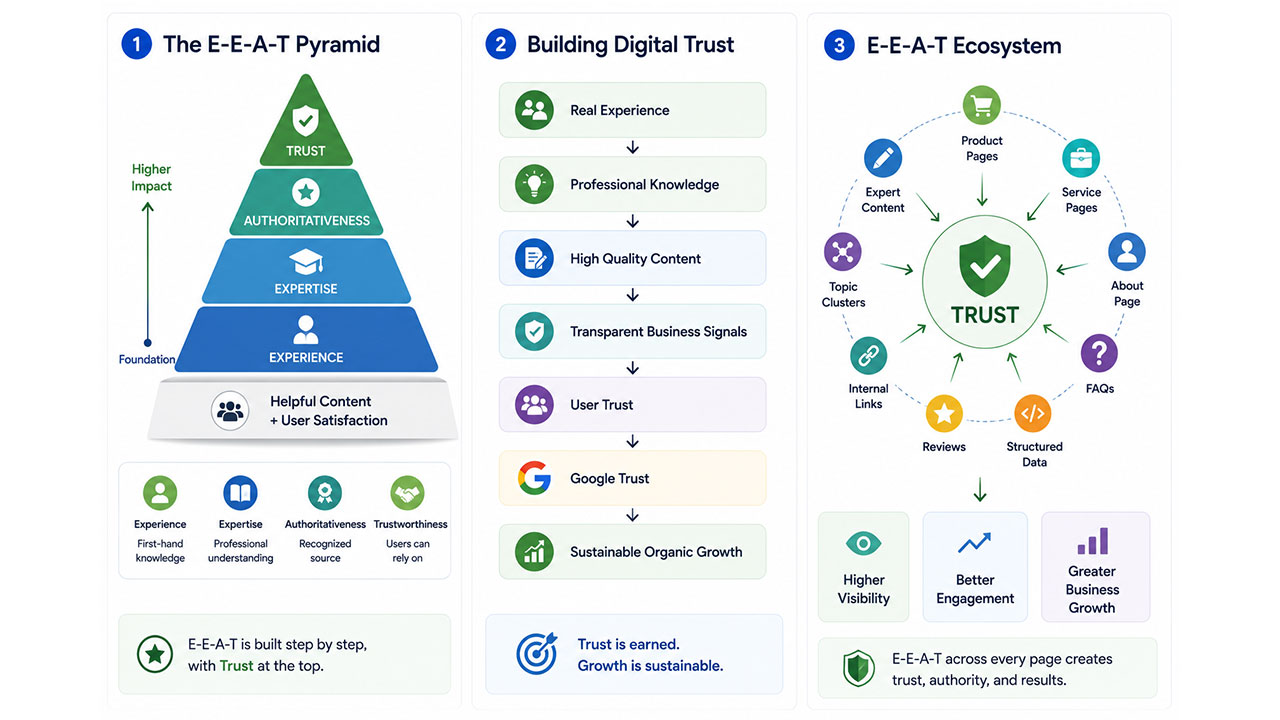
(E-E-A-T Framework Illustration)
These included:
- Expanding product expertise through richer technical descriptions.
- Publishing more authoritative informational content.
- Strengthening topical consistency across related pages.
- Improving structured data implementation.
- Enhancing trust elements throughout commercial pages.
- Creating stronger connections between products and supporting informational content.
Rather than treating E-E-A-T as a standalone optimization task, the project integrated it into the broader content strategy. Every improvement to content quality, internal linking, and structured information contributes to stronger trust signals over time.
As search engines continue evolving toward entity understanding and AI-generated search experiences, these credibility signals are expected to become even more influential.
Conversion Opportunity Analysis
Generating organic traffic is only one stage of a successful SEO strategy. The real business objective is converting qualified visitors into customers.
For that reason, the audit extended beyond rankings and traffic metrics to evaluate how effectively commercial pages supported user decision-making. The analysis indicated that several pages attracted valuable organic traffic but offered limited assistance during the final stages of the buying journey.
Key improvement opportunities included:
- Stronger commercial messaging.
- More persuasive product descriptions.
- Clearer calls-to-action.
- Better presentation of product benefits.
- FAQ sections addressing common purchase questions.
- Initial customer reviews and ratings.
- Improved trust indicators.
- Better contextual navigation toward related products.
These recommendations were designed to improve not only search performance but also the overall commercial effectiveness of the website.
SEO success ultimately depends on business outcomes—not traffic alone.
Internal Linking Analysis
Internal linking is one of the most underestimated components of enterprise SEO. For websites containing hundreds of commercial pages, a well-designed internal linking structure serves multiple purposes simultaneously.
It improves crawl efficiency, distributes authority across important URLs, reinforces topical relationships, and helps users discover relevant products more naturally. The audit found significant opportunities to strengthen semantic connections between commercial pages.
Rather than relying solely on navigation menus, contextual links should connect:
- Related products
- Parent categories
- Commercial landing pages
- Educational resources
- Buying guides
- Frequently asked questions
This creates a stronger topical ecosystem where search engines can better understand how individual pages relate to one another.
A well-structured internal linking strategy also improves crawl prioritization and increases the visibility of strategically important pages.
(Business Growth Opportunities Illustration)
Business Opportunities
(Business Growth Opportunities Illustration)
One of the most valuable outcomes of the audit was identifying where future business growth already existed within the website. Instead of recommending aggressive expansion into entirely new areas, the analysis demonstrated that substantial untapped potential was already present.
Several strategic opportunities emerged:
Increase Click Efficiency
Thousands of additional organic visits could potentially be generated by improving CTR on pages that already ranked well.
Maximize Existing Landing Pages
Many commercial landing pages had already earned search visibility.
Improving their content quality and search relevance offered a faster return than creating new pages.
Strengthen Product-Level SEO
With 736 product pages, even modest improvements applied consistently across the catalog could generate meaningful cumulative growth.
Improve Technical Quality
Resolving indexing inefficiencies, reducing crawl waste, and strengthening page quality would allow search engines to focus more effectively on commercially valuable content.
Prepare for AI-Powered Search
As search engines increasingly rely on semantic understanding, entity relationships, structured data, and natural language retrieval, improving content quality today positions the website for tomorrow’s search landscape.
Rather than viewing AI Search as a separate discipline, the audit recognized it as the natural evolution of modern SEO.
Key Takeaway
The audit revealed that the website’s greatest opportunity was not creating more pages—it was unlocking more value from the pages that already existed. By combining stronger content, improved product optimization, better internal architecture, enhanced trust signals, and conversion-focused design, the website could significantly increase the commercial return from its existing organic visibility.
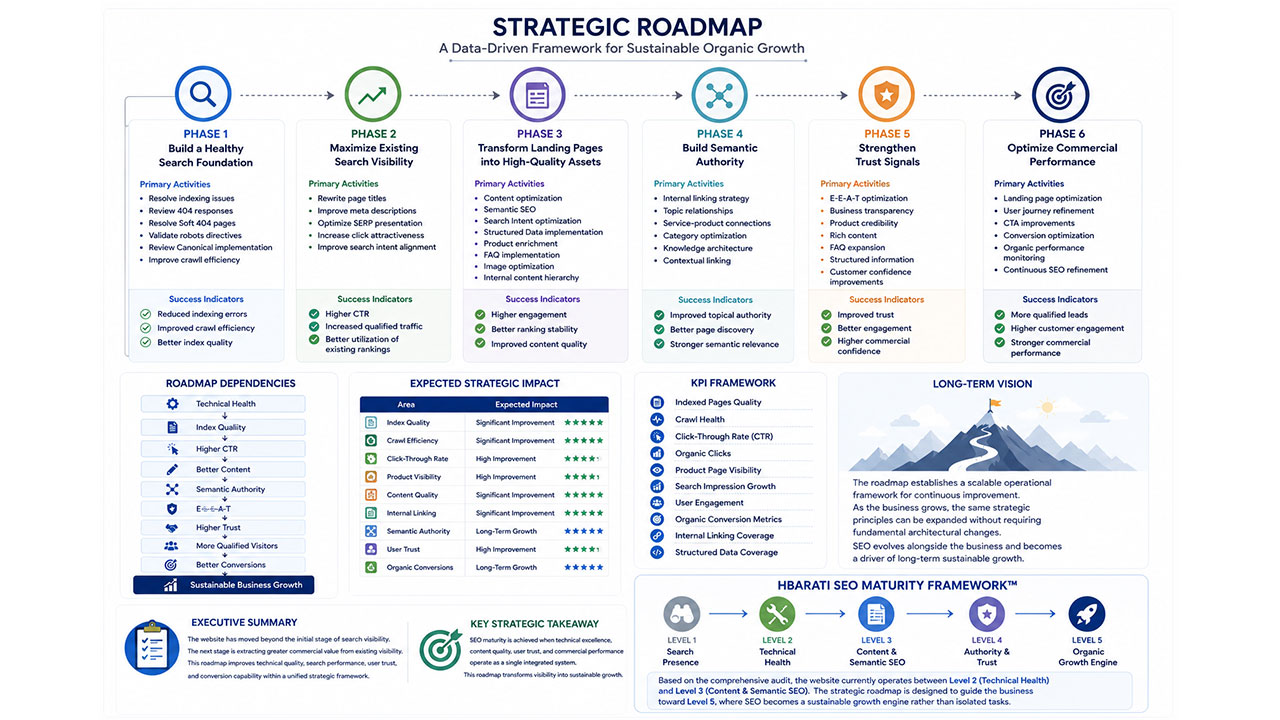
Strategic Roadmap
An SEO audit creates value only when its findings can be translated into an executable strategy. For this project, every recommendation was organized into a phased implementation roadmap based on business impact, technical dependencies, and implementation priority.
Rather than attempting to optimize every aspect of the website simultaneously, the strategy focused on delivering sustainable growth through incremental improvements.
Phase 1 — Technical Foundation
The first phase focuses on improving the website’s technical health by resolving issues that directly affect Google’s ability to crawl and index valuable pages.
Primary objectives include:
- Cleaning up broken URLs (404)
- Resolving Soft 404 pages
- Reviewing blocked URLs
- Optimizing Index Coverage
- Reducing crawl waste
- Improving crawl efficiency
These improvements establish a stronger technical foundation before investing in large-scale content optimization.
Phase 2 — On-Page SEO Optimization
Once the technical foundation is stabilized, attention shifts toward improving the quality of high-value landing pages and commercial content.
Key activities include:
- Optimizing page titles
- Improving meta descriptions
- Implementing structured data
- Strengthening keyword targeting
- Expanding semantic coverage
- Enhancing heading hierarchy
This phase is expected to generate measurable improvements in click-through rate and topical relevance.
Phase 3 — Product SEO Enhancement
The third phase focuses on the website’s largest commercial asset: its product catalog.
Each product page should evolve from a basic inventory listing into a comprehensive landing page capable of satisfying both search intent and purchasing intent.
Optimization includes:
- Unique product descriptions
- Product Schema implementation
- FAQ content
- Image optimization
- Internal linking
- Related product recommendations
- Initial review and rating structure
Because the website contains 736 product pages, consistent optimization across the catalog has the potential to produce substantial cumulative gains.
Phase 4 — Content Authority & E-E-A-T
After strengthening technical and commercial pages, the focus shifts toward building topical authority.
This stage emphasizes:
- Expanding informational depth
- Improving semantic relationships
- Strengthening expertise signals
- Increasing topical consistency
- Building user trust
Rather than publishing more content indiscriminately, the strategy prioritizes improving the quality and authority of existing assets.
Phase 5 — Continuous Performance Optimization
SEO is an ongoing process rather than a one-time implementation.
Once the primary improvements have been completed, continuous monitoring should guide future optimization efforts.
Performance indicators include:
- Organic Clicks
- CTR
- Average Position
- Indexed Pages
- Crawl Health
- User Engagement
- Conversion Performance
Continuous measurement ensures that future decisions remain data-driven rather than assumption-based.
(Business Impact Dashboard Illustration)
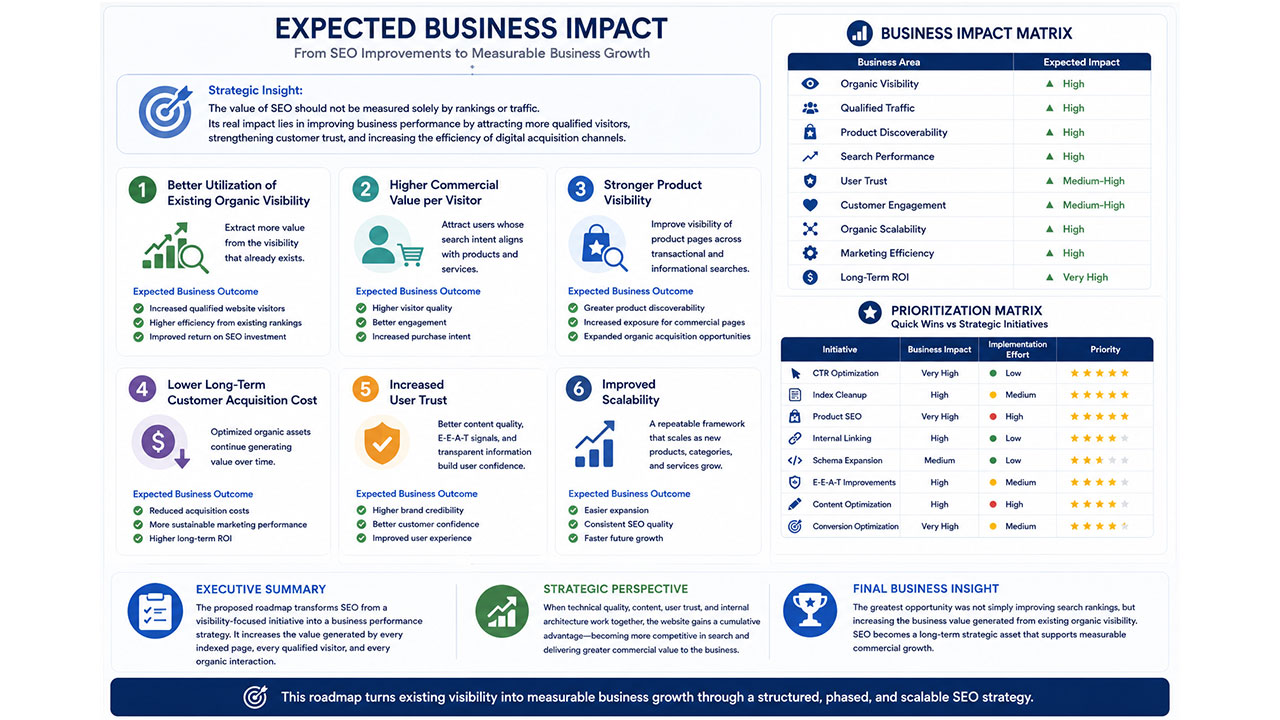
Expected Business Impact
Although no responsible SEO consultant can guarantee rankings or traffic, the audit clearly identified several areas where measurable business improvements are likely once the recommendations are implemented.
The expected outcomes include:
Improved Organic Visibility
Strengthening page quality and technical health enables search engines to crawl, evaluate, and understand the website more effectively.
Higher Click-Through Rates
Improved titles, richer snippets, and stronger search intent alignment can increase the percentage of users who click existing search listings.
Better Index Quality
Removing low-value URLs and improving indexing efficiency allows Google to focus on the pages that contribute most to business objectives.
Stronger Product Performance
Optimized product pages provide greater relevance, richer information, and better commercial signals, increasing both visibility and user confidence.
Increased Topical Authority
A stronger semantic structure improves Google’s understanding of the website’s expertise across its primary business topics.
Higher Commercial Value
Ultimately, the objective is not simply generating more traffic. It is attracting better-qualified visitors and creating more opportunities for business growth.
About My SEO Framework
This project reflects the analytical framework I use when working with SEO projects. Rather than treating SEO as a collection of isolated techniques, I approach every website as a complete search ecosystem where technical architecture, content quality, semantic relevance, user behavior, and business objectives are interconnected.
My methodology combines multiple disciplines into a unified decision-making process.
These include:
- Technical SEO
- Data Analysis
- Search Intent Research
- Semantic SEO
- Entity-Based Optimization
- Information Architecture
- E-E-A-T
- Content Strategy
- Conversion Optimization
- AI Search Readiness
Every recommendation is based on measurable evidence rather than assumptions.
Instead of asking,
“What SEO task should be performed next?”
the guiding question becomes:
“Which improvement will generate the greatest long-term business value?”
This philosophy helps organizations prioritize resources, reduce unnecessary work, and build scalable organic growth.
Final Thoughts
SEO has evolved far beyond rankings and keywords. Modern search engines evaluate websites as interconnected systems where technical quality, topical authority, user experience, structured information, and content credibility collectively determine long-term performance.
This case study demonstrates that sustainable organic growth rarely depends on a single optimization. Instead, it is the result of hundreds of coordinated improvements working together toward a common business objective.
Perhaps the most important lesson from this project is that valuable opportunities often already exist within a website. The challenge is not always creating more content or targeting more keywords.
Sometimes the greatest growth comes from understanding existing data more effectively. When search data is analyzed correctly, it becomes far more than a reporting tool. It becomes a strategic decision-making system capable of guiding long-term business growth.
Download the Full Technical SEO Audit
This online case study presents a condensed version of the project.
The report includes:
- Comprehensive technical analysis
- Google Search Console data interpretation
- Index Coverage evaluation
- Crawl Budget assessment
- Content quality framework
- Product SEO recommendations
- E-E-A-T evaluation
- Conversion analysis
- Strategic implementation roadmap
- Detailed technical evidence and supporting visuals
Continue Exploring My SEO Case Studies
This project is one of several enterprise SEO case studies documenting real-world data analysis, technical audits, and strategic SEO planning.
You may also be interested in:
- Bamomarket SEO Case Study
- MalekpourMIE SEO Recovery Case Study
- Sivan Tasisat Technical SEO Audit